Before the Rankings, There Was the Driveway: Why Pickup Ball Still Raises the Best Young Players
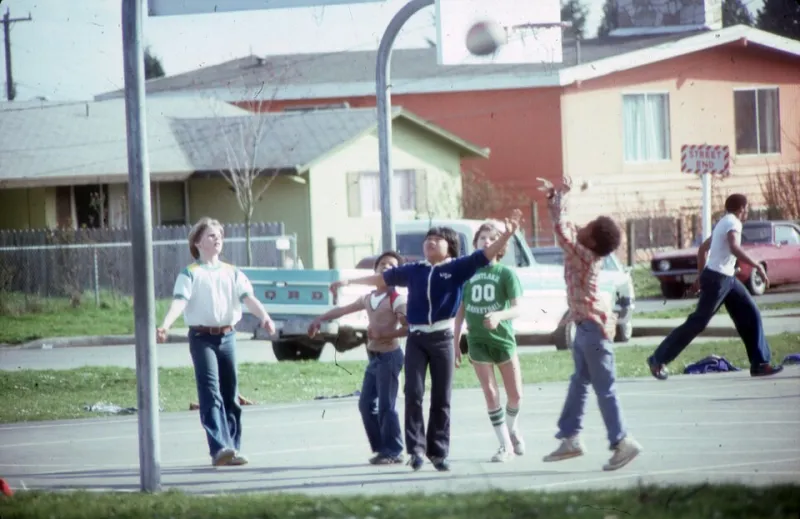
Photo: Seattle Municipal Archives from Seattle, WA, CC BY 2.0, via Wikimedia Commons
The Hoop That Started It All
Ask any coach in America where their best player fell in love with the game, and you'll hear the same story over and over. It wasn't at a showcase in Las Vegas. It wasn't at an elite academy with a $4,000 annual tuition. It was on a cracked slab of concrete behind the garage, shooting until the porch light came on.
There's something almost stubborn about the driveway hoop. It doesn't care about rankings, shoe circuits, or exposure camps. It just sits there, net frayed from a thousand summer afternoons, waiting for the next kid to pull up from three.
And according to the coaches we talked to, that's exactly why it still matters.
What the Schedule Took Away
Let's be honest about how youth basketball works in 2025. Weekends are consumed by tournaments two states away. Practices are scripted. Every possession is coached, filmed, and analyzed. There's real value in all of that — structure teaches discipline, and good coaching accelerates skill development.
But something gets lost in the pipeline, longtime coaches say.
"When I was a kid, you played all day and nobody blew the whistle," says Marcus Delgado, who's coached middle school ball in suburban Atlanta for 18 years. "You learned to score on your buddy who was a foot taller. You learned to argue a call and get over it. You learned that if you lost, you sat until the winning team scored. Nobody taught you resilience. You just absorbed it."
That kind of learning doesn't show up on a stat sheet. But it shows up in games — when the refs swallow the whistle, when the crowd gets loud, when everything falls apart and a kid has to figure it out on their own.
Creativity Can't Be Coached Into a Kid
Watch old footage of the greats — the crossovers, the weird angles, the shots that shouldn't work — and you're watching hours of unstructured play compressed into highlight form.
The driveway is where a kid invents a fadeaway because their older brother blocks everything at the rim. It's where they learn the up-and-under out of necessity, not a drill packet. It's where the game stops being instruction and becomes imagination.
"My daughter plays on two organized teams, and she loves it," says Renee Watkins, a parent of three in Columbus, Ohio. "But the ideas come out when she's out back alone. She comes inside and tells me about this move she 'made up.' I never tell her that some NBA player probably invented it fifty years ago. That's her discovery."
There's a growing body of coaching philosophy — much of it borrowed from European soccer development — that backs this up. Deliberate practice builds technique. Free play builds decision-making. The best programs blend both. The problem, coaches say, is that the free play half of the equation is disappearing.
Toughness, the Old-Fashioned Way
Here's a scene every parent of a certain age remembers: playing against the neighborhood's high school senior, getting absolutely bulldozed, and coming back the next day anyway.
Nobody tracked your minutes. Nobody guaranteed playing time. If you were the youngest out there, you guarded the oldest kid, and you guarded him hard, or you went home.
That's not cruelty — that's an ecosystem. And it's one that structured programs, for all their virtues, struggle to replicate. Age brackets and skill tiers are great for development, but they remove the friction that forges toughness.
The good news? The ecosystem doesn't need to be rebuilt from scratch. It just needs to be invited back. Coaches we spoke with suggest something simple: parents, open the garage. Let the kids in the neighborhood figure out their own games. Resist the urge to organize, referee, or provide snacks.
Love Is the Long Game
Maybe the most important thing the driveway produces isn't a skill at all. It's the relationship a kid builds with basketball when nobody's watching.
A player who shoots free throws at dusk because they want to — not because practice requires it — is a player who'll still be hooping at 35. That love is the foundation everything else gets built on. Travel ball can develop a jump shot. Only joy sustains a career.
So here's the takeaway from the coaches, the parents, and frankly anyone who ever called "next" at a park: keep the schedule, keep the coaching, keep the tournaments. But protect the empty hours too. The unglamorous, unranked, unfiltered hours where a kid and a hoop and a fading afternoon light make each other up.
The next generation of heroes isn't only rising in gleaming fieldhouses.
A lot of them are rising from the driveway — one made bucket at a time.